
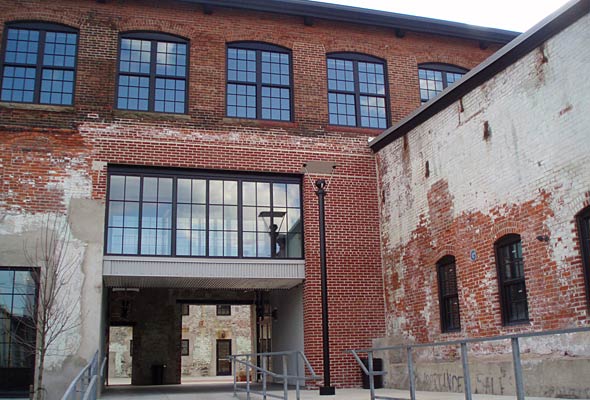
From the Providence Journal
Dyeing company added to register
Tuesday, May 31, 2005
The Providence Dyeing, Bleaching and Calendering Co. complex in Olneyville has been added to the National Register for its contributions to the history of architecture and industry.
The Rhode Island Historical Preservation & Heritage Commission described the building's history:
Built incrementally between 1773 and 1918, the complex is an important example of a textile dyeing and finishing plant, significant for its association with the rise and decline of textile manufacture and finishing and for its association with industrial development along the Woonasquatucket River.
It occupies four acres, or most of the block bounded by the Woonasquatucket River, Valley Street, Delaine Street, and San Souci Drive. The complex includes the Paragon Barn, historically associated with the company's power system until about 1900.
The Patent Calender Co. was founded in 1814 when Henry Hoppin, Hercules Whitney, Edward Mason Jr. and Daniel Bates bought the third steam engine to be used by the textile industry in Rhode Island and the first to be used for finishing cloth.
The firm bought the rights to the first differential calendering machine, which produces finishes to cloth by squeezing it through rollers. The combination of this calendering machine, steam power, geographic location and entrepreneurial zeal soon made the Patent Co. a regional leader in textile finishing.
Reestablished as the Providence Dyeing, Bleaching and Calendering Co., the firm purchased a mill complex at a water privilege on the Woonasquatucket River in 1845. It was named the Valley Bleachery and operated as a bleaching operation. Between 1845 and 1849, the company refitted a stone mill building as a bleach house. Around the time of the Civil War, the Valley Bleachery housed a 60-horsepower steam engine and was bleaching six tons of cloth per day.
In the 1880s, the company closed the Sabin Street location and hired mill engineer Frank P. Sheldon to modernize the Valley Street plant. New construction included a refitted facility for mercerizing fabric. The company was the first in the United States to use this process, in which fabric is immersed in a cold sodium hydroxide solution to make it more receptive to dyes.
The company survived the Great Depression and the war years by finding specialty markets and pursuing technical innovations. When New England textile mills moved to southern states, the company was not able to find an adequate market and closed in 1952. Much of the plant's $300,000 worth of machinery was shipped to southern mills.

